Digital Dental X-Rays in Fredericksburg, VA
Safe, low-radiation digital X-rays at Gateway Smiles in Fredericksburg, VA. Precise diagnosis with up to 90% less radiation than film. Call (540) 299-5721.
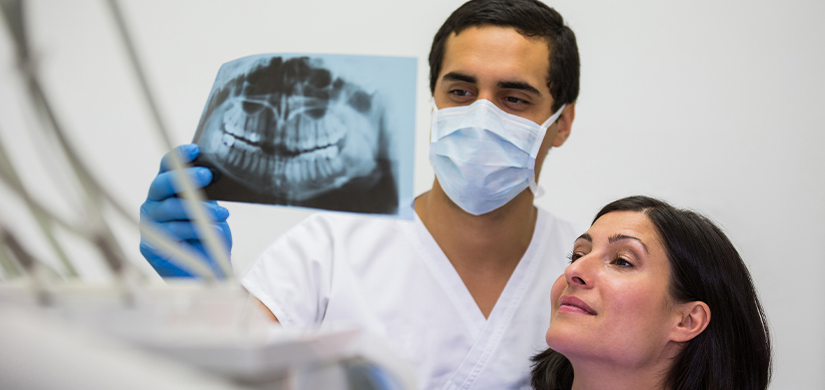
Digital dental X-rays let us see what is happening below the visible surface of your teeth and bone — finding decay between teeth, monitoring root health, evaluating bone levels, and identifying problems long before they cause pain. Modern digital sensors use up to 90% less radiation than traditional film while producing dramatically clearer images.
Why Dental X-Rays Are Essential
A clinical exam alone cannot reveal everything we need to know about your oral health. Many of the most common dental problems — cavities between teeth, infections at the root tips, bone loss around the gums, cysts, impacted teeth, and developmental abnormalities — are invisible to the naked eye until they have progressed significantly.
X-rays let us catch these issues early, when they are smallest and least invasive to treat. A small cavity visible only on an X-ray can be treated with a simple filling. The same cavity ignored for two years may have progressed deep enough to require a root canal and crown. Routine X-rays are one of the single best investments in long-term oral health that you can make.
Types of Dental X-Rays We Use
- Bitewing X-rays show the crowns of upper and lower teeth in one image, used primarily to detect cavities between teeth and evaluate bone levels.
- Periapical X-rays show one or two complete teeth from crown to root, used to evaluate root health, infections, and bone changes around specific teeth.
- Panoramic X-rays show your entire mouth in a single image — all teeth, both jaws, the sinuses, and the TMJ — useful for evaluating overall structure and planning treatment.
- Cone Beam CT (CBCT) provides 3D imaging when needed for implant planning, complex extractions, or evaluation of impacted teeth and pathology.
Digital vs. Traditional X-Rays
At Gateway Smiles, we use entirely digital X-ray technology. The advantages are significant compared to traditional film X-rays. Radiation exposure is reduced by up to 90%, which is especially important for children and patients who need frequent imaging. Images appear on the screen within seconds, so we can review them with you during your appointment. Digital images are easier to enhance, magnify, and analyze for fine detail, leading to more accurate diagnosis.
Digital records are also easier to store, share with specialists when needed, and compare across visits. We can pull up your X-rays from two years ago and place them side-by-side with today's images to spot subtle changes that would be missed in any other way.
How Often Should X-Rays Be Taken?
X-ray frequency is individualized based on your age, oral health history, risk factors, and any current symptoms. For a typical adult with stable oral health, we recommend bitewing X-rays every 1–2 years and a full mouth series or panoramic X-ray every 3–5 years. Patients with active dental issues, high decay risk, periodontal disease, or extensive dental work may need X-rays more frequently. Patients with stable oral health and low risk may need them less often. We follow ADA guidelines on radiology and never take X-rays without a clear clinical reason.
Are Dental X-Rays Safe?
Yes. Modern digital dental X-rays expose you to a very small amount of radiation — a typical set of four bitewing X-rays delivers about the same radiation as a few hours of normal background exposure from the environment, or a short airline flight. We use lead aprons with thyroid collars to shield the rest of the body, and we limit X-rays to only those that are clinically necessary. The diagnostic value of dental X-rays far exceeds the minimal risk of the radiation involved.
X-Rays for Children
Children's dental X-rays use the same low-radiation digital sensors as adult X-rays, with techniques and shielding tailored to their smaller anatomy. We are conservative about taking X-rays on children and only do so when there is a clear clinical need — typically to check for cavities between primary molars, monitor development of permanent teeth, or evaluate any specific concern. We follow strict ADA pediatric radiology guidelines.
Cost and Insurance
Dental X-rays are covered as preventive or diagnostic care under most dental insurance plans. Bitewing X-rays at routine cleanings are typically covered at 100%. More extensive imaging such as panoramic X-rays or CBCT scans is usually covered at 80–100% under diagnostic benefits. Our front desk team will verify your specific benefits before any imaging is taken.
Frequently asked questions
Have more questions about x-rays? Call us at (540) 299-5721 — we're happy to help.
A complete set of four digital bitewing X-rays delivers approximately 0.005 millisieverts of radiation — about the same as a few hours of natural background radiation, or roughly 1/1000 of a single chest CT scan. The dose is very low.
Routine X-rays are typically deferred during pregnancy as a precaution. However, if X-rays are needed for diagnosis or treatment of a dental problem during pregnancy, modern digital X-rays with proper lead shielding are considered safe by both the ADA and ACOG. Let us know if you are pregnant or trying to conceive.
We strongly recommend X-rays when they are clinically indicated, because they reveal problems that are invisible to clinical examination alone. We respect your right to make decisions about your care, but please understand that refusing X-rays may limit our ability to diagnose certain issues and may affect our ability to provide comprehensive care.
We have access to cone beam CT (CBCT) imaging for cases that require 3D evaluation, such as dental implant planning, complex extractions, evaluation of impacted teeth, or certain endodontic cases. We coordinate CBCT imaging when it is needed.
If you have recent X-rays from another dentist, please bring them or have them sent to us. We are happy to use existing imaging when it is recent and of good quality. We only retake X-rays when the existing images are too old, of insufficient quality, or do not show what we need for an accurate diagnosis.

Let's talk about your x-rays
Come in for a consultation with Dr. Zaiber. We'll examine your situation, explain your options, and recommend the right approach — with no pressure to commit.